ECOMMERCE · 2026-11-15 · 6 min read
How Much Does an Ecommerce Website Cost in Pakistan?
By Saqib Usman, Full Stack Developer
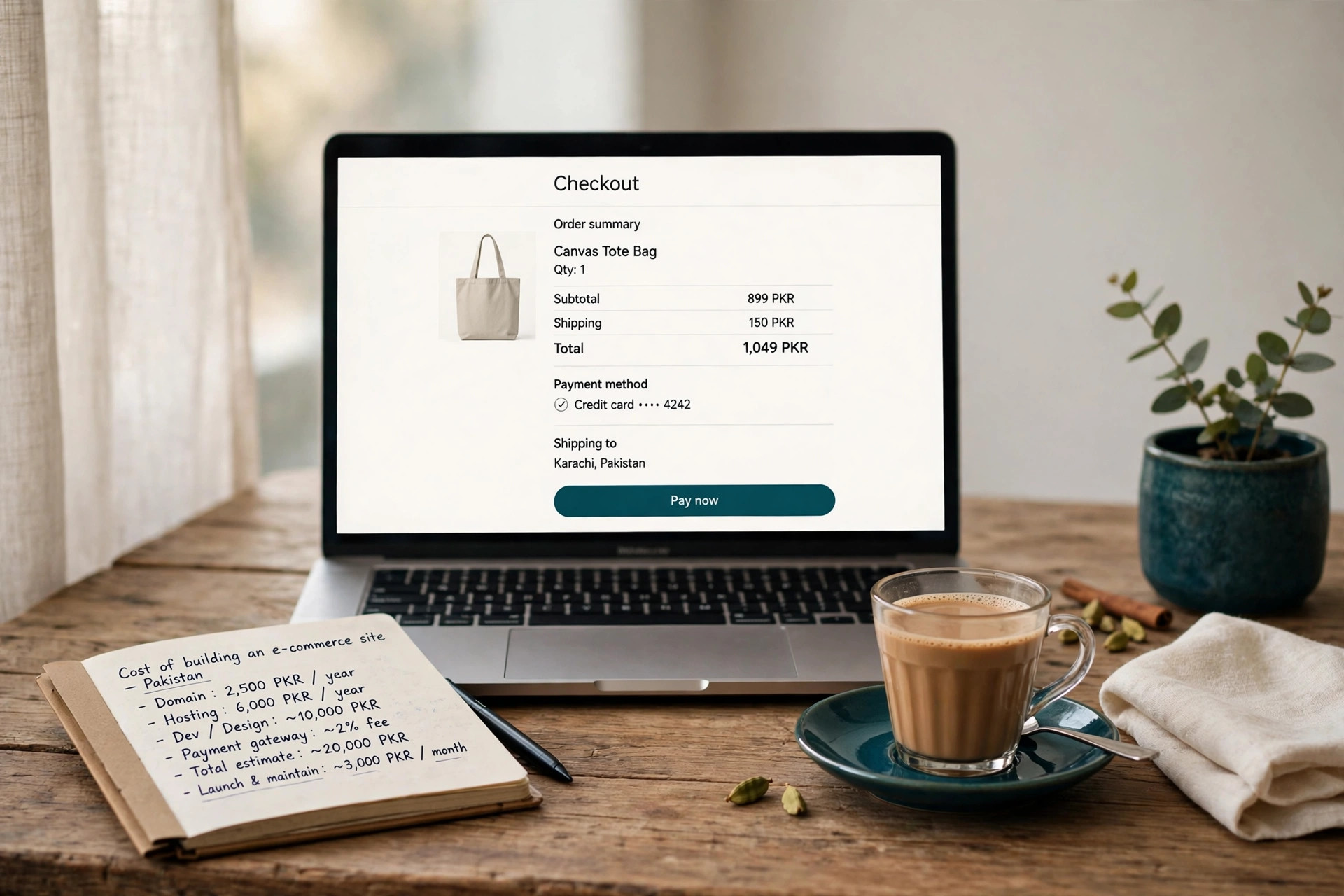
Every week, a shop owner asks me the same question: how much does an ecommerce website cost in Pakistan? The honest answer is that it depends, but not in the vague way people usually mean. A simple online store and a full custom marketplace are different products, and their prices should be different. This article breaks down what each option actually costs in rupees, what is included, and where the hidden costs hide, so you can budget before you talk to any developer.
The short answer: the three price bands
Most ecommerce websites in Pakistan fall into one of three bands. A store built on a ready-made platform, such as Shopify or WooCommerce, usually costs between PKR 50,000 and PKR 150,000 to set up, plus a monthly platform fee. A custom-built store with its own design and features usually starts around PKR 200,000 and can go well past PKR 500,000. A large marketplace or multi-vendor store with separate seller dashboards, commission rules and rider tracking is a different project altogether, and starts around PKR 800,000. The monthly running cost is separate from the build cost, and it matters just as much.
- Ready-made platform store: PKR 50,000 to 150,000 setup, plus monthly fees
- Custom-built store: PKR 200,000 to 500,000 and above, one-time build cost
- Multi-vendor marketplace: PKR 800,000 and above, a much bigger project
- Monthly running cost: hosting, domain, payment gateway and platform fees
What a ready-made platform actually costs
Shopify is the most common choice for a first online store. The monthly plan is the main cost, and it is charged in dollars, so the rupee price moves with the exchange rate. On top of that you pay for a theme, any paid apps you add, and a small fee on every order. WooCommerce, which runs on WordPress, has no monthly platform fee, but you pay for hosting, a domain, a theme and any paid plugins. WooCommerce looks cheaper at first, but the costs are spread across more places, and you need someone to keep it updated. For a small shop selling under a hundred products, either platform works well, and the setup cost is mostly design, product uploading and payment setup, not the software itself.
What a custom store costs, and when it is worth it
A custom store is built for your business only. You get your own design, your own checkout flow, and features a ready-made platform cannot offer, such as a custom delivery pricing rule, a loyalty system, or an admin panel that matches how your shop actually works. That is why it costs more. The build usually takes four to eight weeks, and the price covers design, development, testing and launch. A custom store is worth it when your products, pricing or delivery rules are unusual, or when you plan to grow the store into something bigger, like a mobile app, later. If you only need a simple shop with standard checkout, a ready-made platform gives you the same result for less money.
Payments: the cost most people forget

In Pakistan, most online stores start with cash on delivery, and that is fine, but it is not free. Courier companies charge a COD handling fee, and a percentage of COD orders get returned, which costs you delivery charges both ways. Adding online payments helps, and the common options are JazzCash and Easypaisa merchant accounts, bank transfer, and card payments through a local payment gateway. Each gateway charges a setup fee or a percentage per transaction, usually around 2 to 3 percent. Some gateways also charge a monthly fee. Before you choose, ask for the full fee list in writing, including the per-transaction percentage, the settlement time, and any monthly charge. A gateway that looks cheap on setup can be expensive on every single order.
The monthly running costs, added up
Once the store is live, the monthly costs are hosting, the domain renewal, the platform fee if you use Shopify, payment gateway fees, and any apps or plugins you keep. For a small store, that usually comes to PKR 5,000 to PKR 25,000 a month, before marketing. Marketing is separate, and it is where most new stores actually spend their money: product photography, social media ads and promotions. A store with no visitors makes no sales, so plan a small monthly marketing budget from the start, even if it is only a few thousand rupees for ads and a few good product photos.
- Hosting and domain: a few thousand rupees a month, or yearly for the domain
- Platform fee: monthly on Shopify, none on WooCommerce, but plugins cost extra
- Payment gateway: around 2 to 3 percent of every online payment
- Delivery and COD returns: the most commonly underestimated cost
- Marketing: product photos and ads, budget separately from the build
How to avoid paying too much
Start with the simplest store that lets customers browse, order and pay. You can add features later, once real orders show you what is missing. Ask any developer for an itemised quote: design, development, payment setup, product uploading and training, each on its own line, so you can compare quotes fairly. Check what is included after launch, because a store with no support becomes expensive the first time something breaks. And keep the ownership of your domain, your hosting account and your store admin in your own name. A cheap store that you do not own is not a bargain.
If you are a shop owner thinking about selling online, the cost of the website is the smallest part of the decision. The bigger question is whether you are ready to take orders every day, pack them, and handle returns. If you are, a good store pays for itself quickly, because every order that comes through your own website is an order you did not pay a marketplace commission on. Start small, launch fast, and improve the store with what your customers actually do.
Keep reading.

Want something like this built?
I build restaurant systems, business websites and web platforms for clients. Tell me about your project and I will get back to you.
Start a project →